




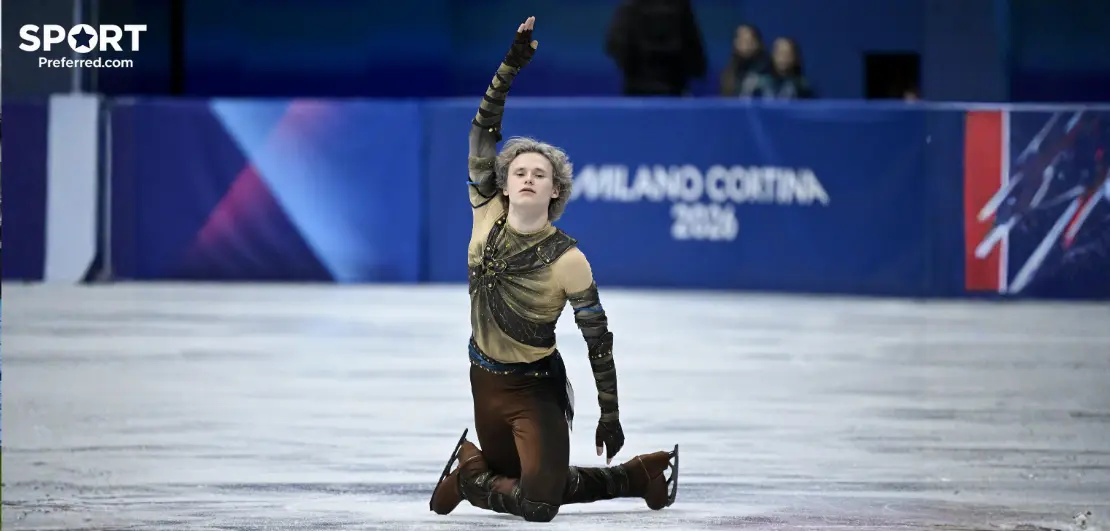
The men’s figure skating event at the Milano Cortina 2026 Winter Olympics has reached its most crucial moment, with the world’s top skaters ready for the free skate that will decide the medals. After a tense and highly technical short program, Ilia Malinin stands at the top of the leaderboard, positioning himself as the standout favourite for Olympic gold.
The competition is unfolding inside the packed Milano Ice Skating Arena, where fans are witnessing one of the strongest men’s fields in recent Olympic history.
Malinin’s Commanding Short Program Performance
Ilia Malinin, widely known for his extraordinary jumping ability, delivered a crisp and confident short program that earned him 108.16 points, the highest score of the night. His clean landings, speed, and precision created an early gap over the rest of the field.
His advantage is meaningful, but not insurmountable—setting up a dramatic free skate where even one mistake could shift the podium.
Short Program Standings (Top 12)
| Rank | Athlete | Country | Score |
|---|---|---|---|
| 1 | Ilia Malinin | USA | 108.16 |
| 2 | Yuma Kagiyama | Japan | 103.07 |
| 3 | Adam Siao Him Fa | France | 102.55 |
| 4 | Daniel Grassl | Italy | 93.46 |
| 5 | Mikhail Shaidorov | Kazakhstan | 92.94 |
| 6 | Cha Junhwan | Korea | 92.72 |
| 7 | Kevin Aymoz | France | 92.64 |
| 8 | Andrew Torgashev | USA | 88.94 |
| 9 | Shun Sato | Japan | 88.70 |
| 10 | Stephen Gogolev | Canada | 87.41 |
| 11 | Kyrylo Marsak | Ukraine | 86.89 |
| 12 | Petr Gumennik | AIN | 86.72 |
A total of 24 skaters advanced to the free skate.
Spotlight on Malinin: Gold Within Reach, History on the Line
Beyond his short program lead, Malinin has drawn global attention for another reason—his ambition to land the quadruple axel, the most difficult jump in figure skating. He has said he may attempt it only if he feels completely confident, prioritising health and safety.
He earned huge applause earlier in the Games after his legal and spectacular backflip in the team event—a move previously banned for decades until the rule change allowed somersault-type jumps again. His combination of athleticism and showmanship has electrified the 2026 Olympics.
If he hits his planned elements cleanly in the free skate, Malinin could secure both gold and a historic technical achievement.
Rivals Who Can Challenge for Gold
1. Yuma Kagiyama (Japan)
Precise, elegant, and consistent, Kagiyama is well within striking distance. His strong short program set up a real fight for the podium’s top step.
2. Adam Siao Him Fa (France)
Technically ambitious with high-scoring potential, he remains a serious medal threat if his quads land cleanly.
3. Cha Junhwan, Daniel Grassl, and others
Each of these skaters has the difficulty and performance quality to climb into medal contention depending on how the night unfolds.
Event Timing and What Comes Next
Men’s Free Skate (Medal Round)
- Date: 13 February 2026
- Time: 19:00 local (UTC+1)
- Venue: Milano Ice Skating Arena
Skaters will perform in reverse order of short program placement, meaning Malinin will close the event—adding to the tension.
How the Men’s Figure Skating Event Works
Short Program
A compact routine requiring:
- One solo jump
- One jump combination
- A required axel
- Spinning and step elements
The margin for error is extremely small.
Free Skate
A longer, more open program allowing:
- Multiple quads
- Second-half bonus
- Greater focus on stamina and choreography
Total scores from both segments determine the medals.
Read more: Madison Chock & Evan Bates Win Silver in Ice Dance at Milan-Cortina 2026
Why the Free Skate Is Always the Decider
The final minutes of the free skate often decide everything. Skaters who maintain control under pressure—steady edges, full-level spins, secure jumps—rise above those who fade late.
Strategy also shifts:
- Leaders may choose a safer layout
- Chasers may upgrade to riskier jumps
The panel’s judging pattern during the event can also influence last-minute coaching decisions.
Full Short Program Qualification List (Ranks 1–24)
| Rank | Athlete | Score |
|---|---|---|
| 13 | Jin Boyang (CHN) | 86.55 |
| 14 | Maxim Naumov (USA) | 85.65 |
| 15 | Nika Egadze (GEO) | 85.11 |
| 16 | Matteo Rizzo (ITA) | 84.30 |
| 17 | Deniss Vasiljevs (LAT) | 82.44 |
| 18 | Aleksandr Selevko (EST) | 82.02 |
| 19 | Lukas Britschgi (SUI) | 80.87 |
| 20 | Adam Hagara (SVK) | 80.30 |
| 21 | Vladimir Samoilov (POL) | 77.57 |
| 22 | Kao Miura (JPN) | 76.77 |
| 23 | Donovan Carrillo (MEX) | 75.56 |
| 24 | Li Yu-Hsiang (TPE) | 72.41 |
These skaters complete the free skate lineup.
Skaters who sustain stamina and confidence into the final minute tend to protect their scores best.
The men’s event now moves toward an electrifying conclusion. With Ilia Malinin leading the pack and the pressure of Olympic gold on the line, Milano Cortina is set for a night of skating brilliance, high drama, and potential history in the making.
FAQs
1. When is the men’s free skate at the 2026 Winter Olympics?
The medal event takes place on 13 February 2026 at 19:00 local time.
2. Who is leading after the short program?
Ilia Malinin holds the top position with 108.16 points.
3. How many skaters qualify for the free skate?
The top 24 athletes from the short program advance.
4. Can Malinin attempt the quadruple axel?
Yes, he may attempt it if he feels physically and mentally ready.
5. How is the final medal decided?
The combined total of the short program and free skate determines the podium.
6. Does Team USA have multiple finalists?
Yes—Malinin, Andrew Torgashev, and Maxim Naumov have all qualified.
7. How important is the free skate?
It carries a higher score value and usually determines the final rankings.
 Add as a preferred source on Google